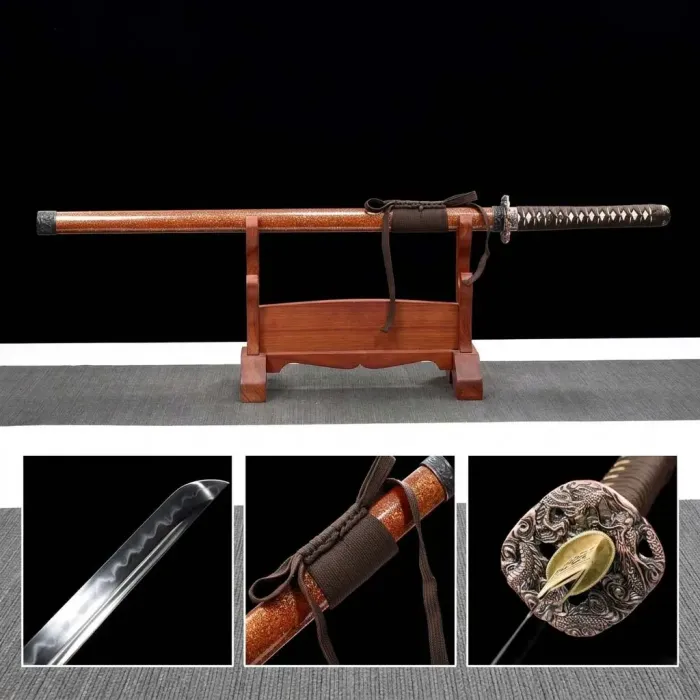
An time-honored samurai blade stands a magnificent display of technique, but what if you seek to express your unique mode? Adapting your tool is a meaningful journey, allowing you to fashion a truly one-of-a-kind piece. From the shaft wrapping and sheath to the handpiece design and heat mark, each aspect offers a chance for specialized modification. This study delves into the territory of katana modifications, providing guidance for both learners and seasoned enthusiasts aiming to inscribe their impression on the time-honored art of the samurai.
Primary Authentic Workmanship
For starters motivated to embark on the fulfilling journey of eastern weapon training , 1060 steel katanas present an ideal entry point. This defined grade of essential steel reaches a perfect balance between expense and excellence . While lacking compared to hard as premium steels, 1060 permits a acceptable level of cutting preparation , making it suited for initiates to learn the basics of weapon preservation and admire the allure of classic Japanese weaponry. It’s a remarkable choice for obtaining experience without the economical burden of more enhanced steels.
Grade T10 Cutlasses: Combining Potency and Economy
Enabling devotees seeking an authentic cutting instrument experience without crossing the bank , T10 steel katanas represent a advantageous option. These implements offer a clear improvement in lastingness compared to basic alternatives, exhibiting respectable edge retention and enough flexibility for fundamental slicing techniques. While not rivaling the superior characteristics of fine steels like T100 or folded element , T10 provides a commendable blend of efficiency and cost-effectiveness , making them a widespread choice for beginners and those on a modest salary .
Exceeding the Sword : Personalizing Your Tool's Accessories and Hilt
Even though the polished metallic edge is undeniably the core point of a katana, truly enhancing its magnificence lies in the precise customization of its ornamentation and tsuka . This technique allows collectors to express their exclusive preference . Assess the extensive possibilities: menuki - decorative decorations that bring visual interest ; the hamon protective covers – often carefully engraved ; the tsuka center itself, wrapped in orthodox ito yarn; and the fusa cap, which can be created from various materials like ornaments or bone .
- Decide on motifs that relate with you.
- Try with alternative substances .
- Value quality for a persistent impression .
The Attraction of the Katana: Legacy, Artistry, and Steelwork
A oriental cutlery shows a distinctive allure, steeped in eras of Japanese history and heritage . More than merely a artificial item of skirmishing, it's a embodiment of the knight ethos – a fusion of prowess and self-control . Its advancement spanned countless generations, with early arms evolving into the elegant curvature and dangerous edge we accept today. The construction involved is truly extraordinary , requiring long periods of instruction to complete. The process involves a complex folding of forged iron , creating layers that boost the steel’s flexibility and cutting ability. Various schools of blacksmithing started , each with their special secrets and formulas for achieving the ideal equilibrium and keenness - a truly challenging pursuit.
- Preliminary Katana forms
- The role of the nihonto in fighter culture
- Conventional fabricating styles
Determining the Optimal Steel for Your Sword Project Project: 1060 vs. T10
Selecting the suitable steel is vitally important for any cutting weapon project, and the determination between 1060 and T10 can be difficult. 1060 is a widely used American alloy, offering a reasonable balance of durability and resilience, making it relatively easy to heat treat. However, T10, a Asian steel, habitually boasts amplified wear fortitude and can likely achieve a increased conclusive hardness, although it sword custom can be considerably demanding to work with and requires refined heat modifying. Consider your capability and targeted characteristics: for a newcomer, 1060 may be a prudent inception, while the veteran smith might prefer the extra merits of T10.
- Accessibility of Controlling
- Corrosion
- Peak Hardness
Unleashing the Power: High-Level Katana Modification Methods
Becoming proficient in blade improvement extends far beyond basic grinding. Serious experts are now exploring advanced techniques to truly discover a blade's hidden potential. This entails intricate work with the heat signature, utilizing specialized products for differential heat treating and carefully nominating the contour of the tsuba to optimize balance and quality. Beyond purely functional modifications, artisans are increasingly focused on realizing unparalleled aesthetic charm, through complex etching and layered textures that truly transform a katana into a masterpiece.
Transforming Basic Steel into Art: Building a 1060 Sword
The journey initiates with common 1060 material , a rigid material far apart the polished katana it will shift into . Skilled bladesmiths practice a complex process of doubling and constructing the base steel, repeatedly annealing it and pounding it to clear impurities and fashion a even grain structure. This arduous process, often enduring for periods , builds the important resilience and suppleness characteristic of a standard Japanese blade . Extra heat refinements, including accurate hardening and conditioning , are mandatory to achieve the intended steadiness of sharpness, persistence and magnificence.- Layering: Minimizes impurities and constructs grain structure.
- Constructing: Forms the steel into the initial blade form.
- Quenching: Controls the final hardness and flexibility.
The Perpetual Attraction of the Katana: Extensive Study of Steel and Alteration
That long-standing katana survives a powerful symbol for Japanese artistry , its charm far overtopping mere arms and armor . Forged from traditional steel and usually featuring intricate designs , the process of creation itself is a revered art. Beyond the core craftsmanship, the ability to modify a katana - from the temper curve to the grip wrapping and band - permits for a perfectly individual manifestation for both devotees and operators alike. This union of legacy steelwork and boundless personalization effectuates the katana's continued prestige across the terra .
